

Start with the experience, then plan the golf
Most golf trip planning starts with the courses. Vegas is the one destination where that's the wrong first question. The first question is what kind of trip you're actually building — because Las Vegas can be a serious golf pilgrimage, a nightlife trip that happens to include a few rounds, or a genuine hybrid, and the answer changes almost everything downstream: which courses you prioritize, how many days you need, and whether this stays a Vegas trip at all or turns into a bigger desert road trip. Decide that first. Everything else in this guide follows from it.
Decide what kind of trip this is before you book anything
There are really three versions of a Vegas golf trip, and trying to do all three at once is the most common way groups end up frustrated.
The bucket-list version centers on one or two rounds that are the whole point of the trip — Shadow Creek, Wynn Golf Club, or both — with the city as a backdrop to a golf pilgrimage. The value version skips the marquee rounds entirely and builds a real, high-quality golf week around the accessible courses, keeping the Strip as an evening add-on rather than the center of gravity. The hybrid version treats golf as the daytime activity and the city as the actual headline, playing one solid round a day and letting the evenings run long. None of these is the "right" answer — Vegas is unusual in that all three genuinely work — but your group needs to agree on which one you're doing before anyone starts calling courses, because the booking sequence is different for each.

If the bucket-list round is the point: Shadow Creek and Wynn
If your group has talked about Shadow Creek or Wynn Golf Club for years, this is the trip to do it, and it's worth understanding exactly how access works before you build a budget or an itinerary around either one — because the common assumption about both of them is wrong in one direction or the other.
Shadow Creek is the harder one to get into and the rules are real: you have to be a registered guest at an MGM Resorts property to book at all, weekend tee times are effectively reserved for comped high-rollers working through a casino host, and Monday through Thursday is where an ordinary paying guest actually has a shot at a time. Book your MGM hotel stay first, then call the course directly — don't assume you can add Shadow Creek onto an already-booked non-MGM hotel stay after the fact.
Wynn Golf Club is the one people get backwards. It is not restricted to hotel guests — it's genuinely public, bookable by phone whether or not you're staying at the Wynn or Encore. What hotel guests get is a longer booking window, roughly three months out versus about a month out for everyone else, not exclusive access. If your group isn't staying at the Wynn but wants the round, the move is simply to call earlier relative to your date than a hotel guest would need to, not to rebook your hotel around it.
Both courses run at a genuine premium, priced more like a once-in-a-trip experience than a green fee, and neither publishes a simple seasonal rate sheet — call ahead rather than budget from an old number. If one of these rounds is the anchor, book that date before anything else in the trip, then build lodging and the rest of the week's golf around whichever weekday or window you actually secured.

If you want a real golf week without the bucket-list price tag: Cascata, TPC Las Vegas, and Paiute
This is how most groups should actually build a Vegas golf trip, and it doesn't require an MGM or Wynn hotel stay at all. Cascata is the best single step-up round in this tier — dramatic routing, real scenic drama, priced like a genuine feature day rather than a bucket-list splurge. TPC Las Vegas is the dependable desert-championship round that plays fair and produces a scorecard your group will actually talk about, no hotel requirement attached. Paiute's Wolf and Snow courses, away from the Strip, are where a Vegas trip becomes a volume destination — wide corridors, strong conditioning, and the deepest tee-time inventory in the market, meaning same-week booking is realistic even for a trip planned a few weeks out rather than months.
Build the week around this tier and 36 holes a day is a genuinely reasonable pace, something that isn't true if Shadow Creek or Wynn is on the itinerary. Book Cascata a few weeks out for a weekend morning time; Paiute can often be booked inside the same week except on the busiest weekends.
Deciding whether to extend the trip beyond Vegas
Vegas sits within reach of two real golf extensions, and whether either makes sense depends entirely on how much time your group has and how golf-serious it is.
Mesquite, about 80 miles northeast, is the closer call: Wolf Creek is a genuine desert spectacle — dramatic canyon elevation, risk-reward holes built for stories rather than low scores — and it works well as a single dedicated feature day tacked onto a standard Vegas trip. Coyote Springs, roughly halfway there, is the quieter, more strategic alternative if your group wants serious golf without the spectacle. Either works as a day trip; neither requires restructuring the whole itinerary.
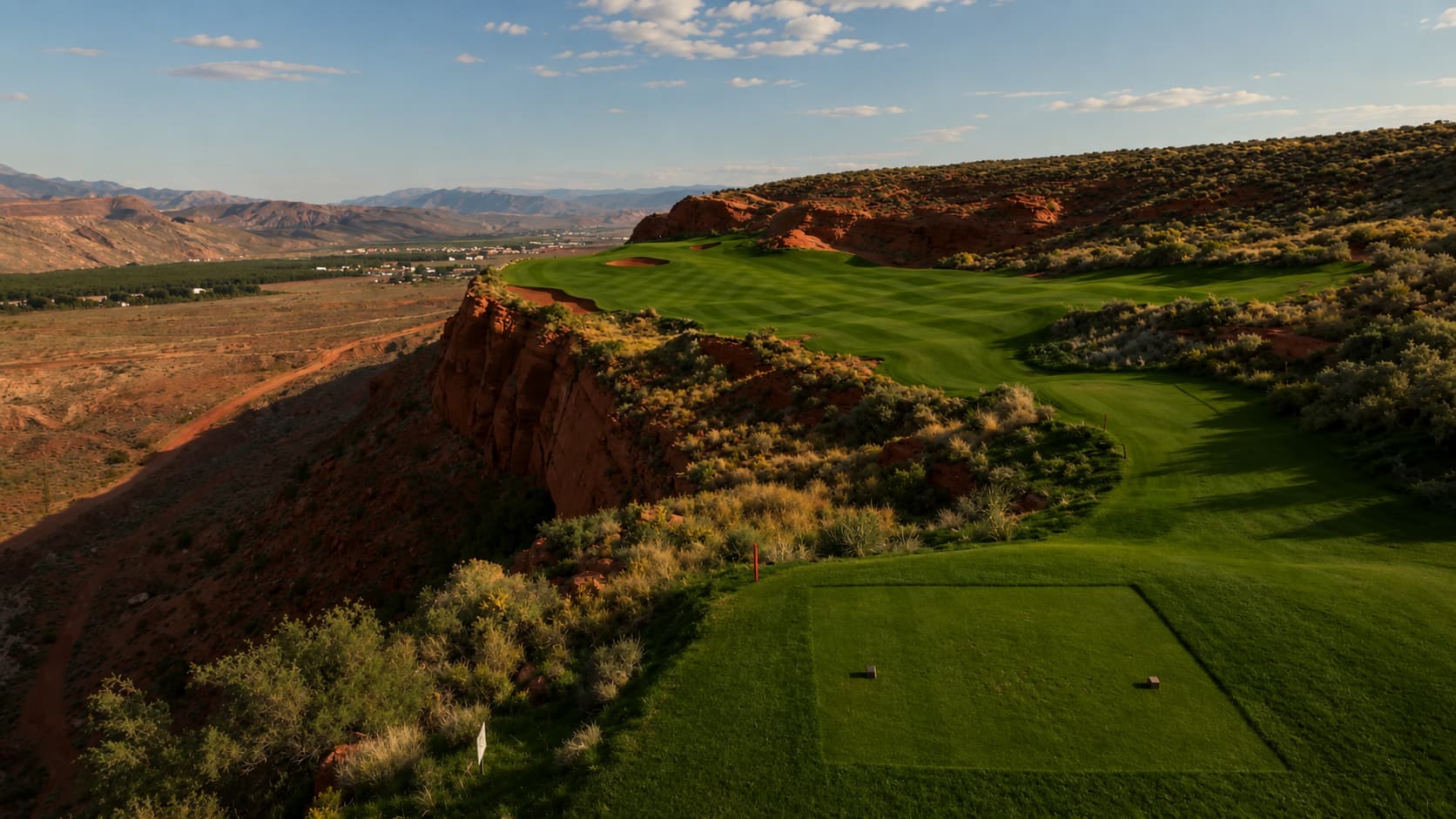
Southern Utah, about two hours up I-15 near St. George, is the bigger decision. This isn't a day trip — it's a genuinely different multi-day golf destination in its own right, built around red rock and lava-field courses like Black Desert and Sand Hollow, and it only makes sense if your group has five or more days and is willing to turn this into two distinct trips back to back rather than one Vegas week. Don't bolt this on as an afterthought to a three-day Vegas trip; it deserves its own days, its own pacing, and ideally its own lodging base near St. George rather than a long day-trip out and back.
The honest planning rule: if your trip is three to four days, stay in the Vegas metro and use Mesquite as your one feature day. If it's five-plus days and the group is serious about golf over nightlife, Vegas plus Southern Utah as two connected legs is one of the strongest desert golf trips available in the country — just plan it as two trips sharing a highway, not one trip with a long day trip attached.
Sequencing the booking
Book in this order, regardless of which version of the trip you're building. First, lock the bucket-list round if there is one — Shadow Creek or Wynn — since that date is the most constrained thing on the itinerary and everything else should flex around it, not the other way around. Second, book your hotel base, choosing MGM if Shadow Creek is the anchor. Third, fill in Cascata, TPC, and Paiute around whatever days remain; these have the most flexible availability and can be booked last without real risk. Fourth, decide on Mesquite or Southern Utah only after the core week is set, since both are add-ons to a plan rather than the plan itself.
Timing matters here in a way it doesn't at every desert destination: fall through spring is comfortable golf weather, and summer turns this into a heat-management exercise with mandatory early tee times rather than a relaxed pace. If your group wants to sleep in and still play, don't book a Vegas golf trip for July or August.
Common planning mistakes
Assuming Wynn requires a hotel stay and rebooking lodging you didn't need to change is the single most avoidable mistake on this list — call and book the round on its own merits first. Booking Shadow Creek for a weekend without confirmed host or comp status is the second, and it usually means the round simply doesn't happen. Treating Southern Utah as a quick add-on to a short Vegas trip, rather than the second leg of a longer one, is the third — it shortchanges both destinations. And building an itinerary around 36 holes a day without being honest about how "Vegas-heavy" the evenings are going to be is the fourth: the city has a way of turning a disciplined golf schedule into a much later, much looser one by the second night, and it's easier to plan for that upfront than to fight it once you're there.
For the full course-by-course breakdown, budget ranges, and sample itinerary, see our Las Vegas golf trip review. For the broader planning framework this guide builds on, see how to plan a golf trip, and for what to actually pack for desert golf, see our golf trip packing list. Browse our full golf trip rankings to see how Vegas compares to every other destination in the Southwest region.