
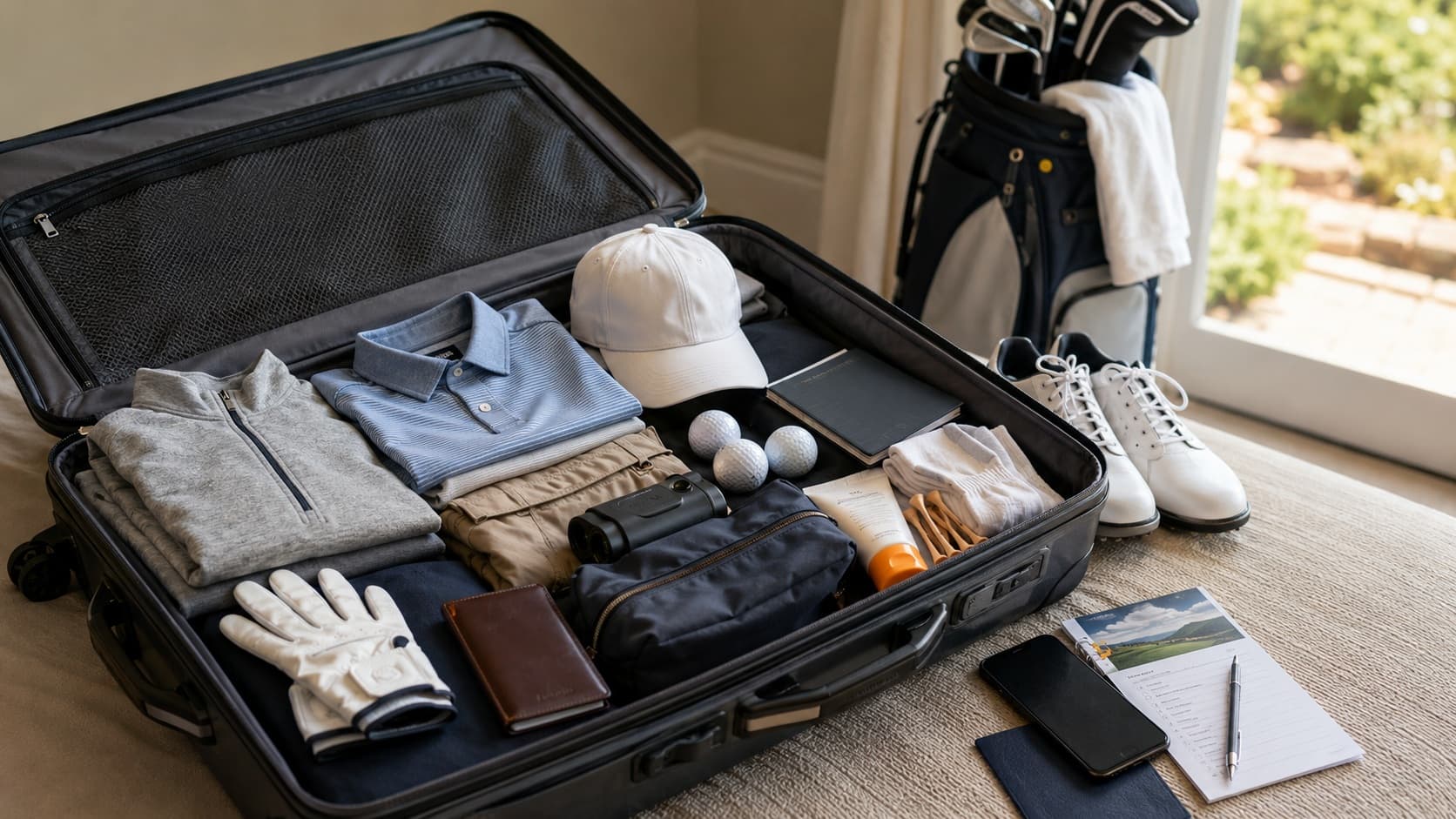
An Expert's Guide on What to Pack for Your Next Golf Trip
Every golf trip packing conversation starts in the wrong place. People ask what clubs to bring, what shoes to pack, whether to bring the full bag. The decision that actually determines how you pack is simpler: are you flying with your clubs or shipping them?
Everything else follows from destination type. A Bandon Dunes trip and a Scottsdale trip have almost no overlap in what you actually need. The packing list for a coastal links course in June looks nothing like the list for a desert resort in April. This guide covers three destination types: coastal links courses (Bandon Dunes, Arcadia Bluffs, Whistling Straits), desert golf (Scottsdale, Las Vegas, Palm Springs), and resort or Southeast trips (Pinehurst, Sea Island, Kiawah Island). Get the destination type right first, then pack accordingly.
The Clubs Question: Fly or Ship
Shipping wins in three situations: multi-stop itineraries where baggage routing gets complicated, trips into small regional airports where handling is rough, and any trip where your equipment is worth protecting seriously. Bandon Dunes routes through North Bend (OTH), a small airport where baggage handling is not gentle. If your clubs are worth more than $2,000, ship them.
Ship Sticks and Ship Point to Point are the two main options. Budget $80 to $150 each way and book one to two weeks out. Clubs arrive two to three days before you land, which means you need a destination address ready when you book. Most golf resorts are familiar with the process.
Flying with clubs is fine for most trips. Airlines charge $35 to $75 per bag each way depending on carrier. A soft travel cover works for the majority of trips to major airports. A hard case is the right call for Bandon (Coos Bay handling is rough) and for any set worth more than $2,000.
One carry-on tip that most people skip: if your driver shaft is expensive, remove the driver head and hand-carry it onto the plane. Airlines have liability caps on sports equipment that will not cover the replacement value of a high-end shaft. A detached driver head fits in any carry-on bag or personal item. This takes 30 seconds and eliminates the most common single-item loss.
Coastal Links: Bandon Dunes, Arcadia Bluffs, Whistling Straits
The rain jacket is the most important item in your bag for a links trip, and most people underpack it. Not a light windbreaker. Not a water-resistant shell that handles a quick shower. A real waterproof jacket rated for sustained rain. Gore-Tex or equivalent. June at Bandon averages 55 degrees with 20 mph wind at tee time, and the weather changes without warning. If you are playing four or five rounds, you will play in rain at some point.
Waterproof shoes follow the same logic. Wet feet ruin rounds in ways that no other discomfort quite matches. If you are spending $300 to $400 per round at a destination course, spend the money on waterproof footwear.
A wind vest and a base layer matter even in summer. The Pacific Coast in June is not warm golf weather. A mid-layer you can strip off by the back nine is more useful than a heavy jacket you are stuck wearing.
Balls: bring 50 to 60 percent more than you think you need. Links courses punish offline shots into fescue and waste areas in ways that tree-lined parkland courses do not. Budget two dozen balls per day for average players. Budget more if you tend to spray it offline. This is not an exaggeration.
Bring extra tees. Links courses have firm teeing grounds where plastic tees snap. Bring more than you pack for a normal round. Bring an extra glove: wet grip deteriorates, and rotating gloves between nines and letting them dry makes a real difference over a four-round trip.
What most people forget: a small dry bag or waterproof stuff sack for your phone, wallet, and scorecard. Jacket pockets are not waterproof. In sustained rain, your phone will get wet through the pocket fabric within an hour. A small dry sack costs $8 and clips to a bag strap. Pack one.
Desert Golf: Scottsdale, Las Vegas, Palm Springs
The priority in the desert is sun protection, not warmth. Two pairs of gloves, because heat degrades grip faster than cold does. Light, breathable shirts in fabrics that wick moisture. A full-brim hat, not a visor: ear and neck coverage matters during a four-hour afternoon round in 95-degree heat.
Sunscreen rated for full-day outdoor use. Apply before the round, not on the first tee. By the time you remember it on the first tee, you have already been in the sun for 20 minutes. Apply at the hotel before you leave. Sunglasses with UV protection matter more in the desert than almost anywhere else: glare off desert sand and cart paths is significant, and it affects ball tracking through the air.
Hydration is where most people underestimate the desert. Cart water is warm and inconvenient. Bring a water bottle you fill before the round. Start drinking before you feel thirsty, not when you are already parched. Desert dehydration comes on fast and degrades both judgment and ball-striking well before you feel physically bad.
Extra tees: desert hardpan is brutal on plastic tees. You will snap more tees in a desert round than in a normal round.
What most people forget: an electrolyte supplement. Packets or tablets, available at any drugstore for about $10. Water alone does not replace what you lose in heat over four hours. This is not optional for afternoon rounds in peak summer. The difference between a back nine in July in Scottsdale with electrolytes and without is significant and measurable. Bring them.
Pack a change of shirt for the 19th hole. Four hours in desert heat means your shirt will be soaked through by the time you finish. A fresh shirt in your bag or in the car is worth the three ounces of space it takes.
Resort and Southeast: Pinehurst, Sea Island, Kiawah
Resort trips in the Southeast require less specialized preparation, but there are three things that catch people off guard.
The first is dress code. Pinehurst No. 2 enforces a collared shirt requirement and prohibits cargo shorts. Several other premium resort courses have similar requirements. Check the dress code for your specific courses before you pack, not when you are standing at the bag drop. A non-collared rain jacket can disqualify you on some courses, which leads directly to the second item.
Pack a collared rain jacket specifically for resort trips. A hooded non-collared pullover violates the dress code at some courses. The rain jacket needs to meet the same presentation standard as your regular golf shirts. This seems minor until you are standing in the rain at a premium course without a compliant rain layer.
The second thing people underpack for resort trips is sheer volume of clothing. Southern resort golf in spring or fall involves three or four rounds over three to four days. Pack enough shirts and shorts to not repeat outfits. Laundry service is available at most resorts, but it costs money and takes time.
The third thing: check whether your courses require soft spikes before you travel. Most resort courses do. Metal spikes are not allowed at Pinehurst, Sea Island, or most comparable properties.
What most people forget: a light pullover for early morning tee times in fall. October mornings in the Sandhills are 48 to 52 degrees at 7 AM. The afternoon will be fine. The first four holes at dawn will not be.
The Things That Don't Fit a Category
Divot tool and ball markers: some courses do not stock them at the pro shop, or only carry overpriced logo versions. Bring your own.
Sharpie: mark your ball before the first round. On courses with heavy rough, ball identification matters and saves you from losing a ball you actually found.
Pain reliever: three or four rounds in four days produces back and knee soreness in people who do not experience it during their normal Saturday round. The volume is different. Pack it.
Small cash: for caddies (cash only at most courses), halfway house stops, and bag drop tips. Budget $40 to $60 per round for tips at premium destinations. This is realistic and not optional at places where caddies loop every bag.
Scorecard holder or yardage book sleeve: protects your scorecard and yardage book in wind and light rain. Costs $5. Worth it.
A backup GPS device or charged phone with a golf app: batteries die. A round without a rangefinder or GPS is a frustration you do not need at a destination course.
The packing list for a links trip and a desert trip have almost no overlap. Pack for the destination, not for golf in general. The one universal: bring more balls than you think you need, more cash than you think you will spend, and one fewer clothing item than you planned. You will buy a shirt at the pro shop anyway.
For the full planning sequence before you get to packing, see the golf trip planning guide. For destination rankings and cost estimates, see GTI's full trip rankings.